
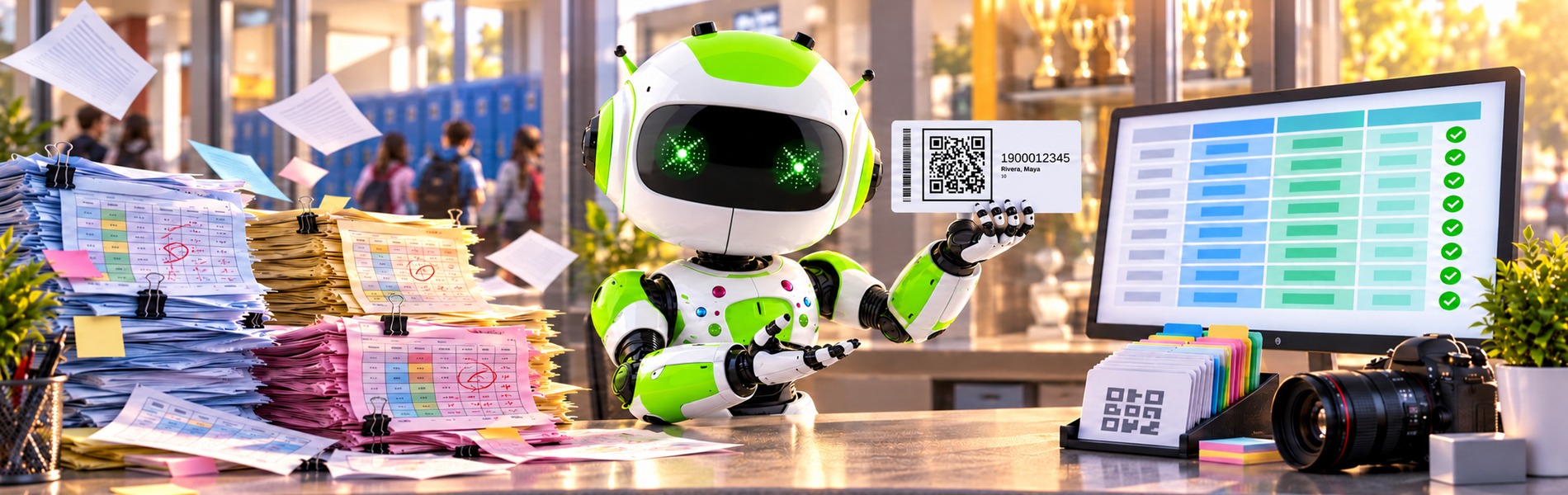
He fixes every school database before picture day.
Schools are never going to send you clean data. Stop waiting for them, and stop fixing it yourself.
For years, we fixed every underclass database by hand.
Every school, every fall. Names jammed into one column. Three files for one school. Seniors mixed in with the underclassmen. No school name anywhere. During busy season, that cleanup ate 5 to 10 hours of our week.
And we always asked for it the right way. We sent the school a request email and a master file showing exactly how we needed the data. It still came back wrong.
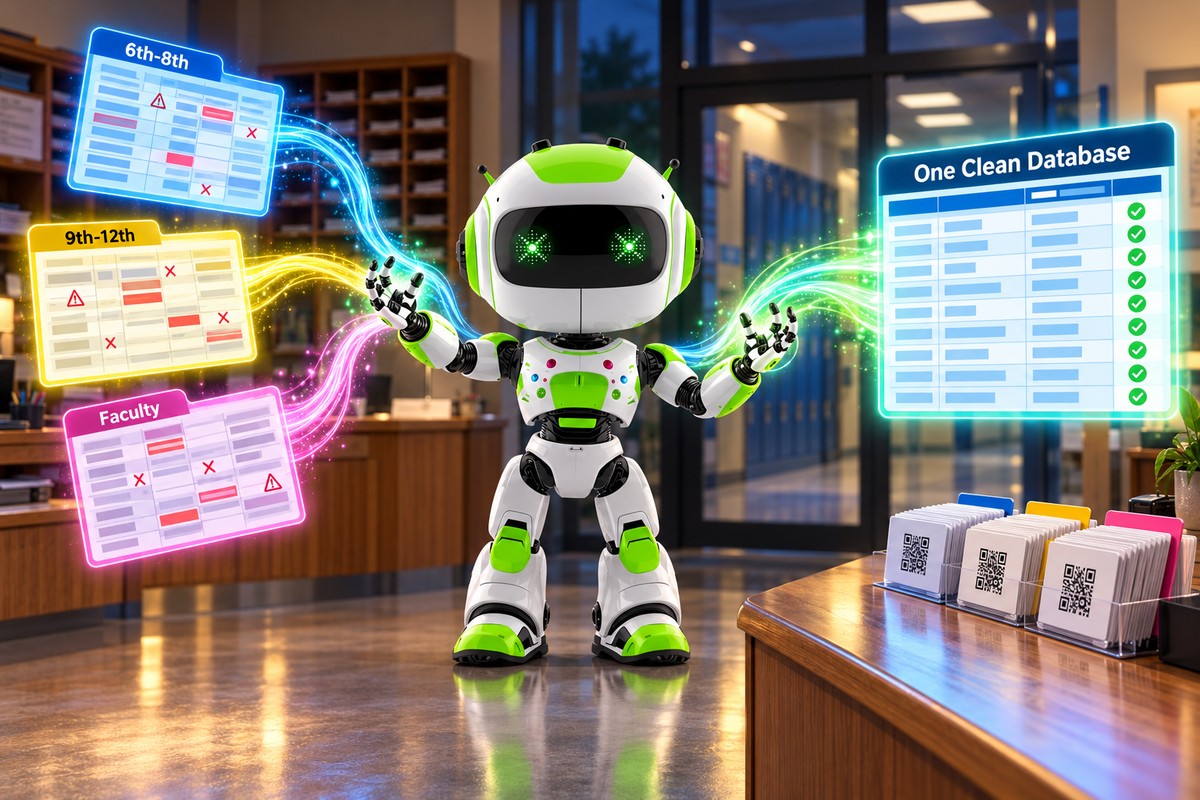
This week was a perfect example. One of our schools sent its data for the third time, after we'd asked them to fix it twice. Student first and last names were still in the same column. And instead of one file, they sent three: one for 6th through 8th grade, one for 9th through 12th, and one for faculty.
You know how this goes. You email, you wait, they don't answer. A week goes by, photo day is coming, and you end up fixing it yourself.
Not anymore. That job took 2 minutes and 4 seconds, and I worked on something else while it ran.
That work is completely automated now, and it's off our plate for good.
Here's the thing. In a school photography workflow, the shooting is the easy part. The school picture day data is what eats your evenings. Schools have office staff whose job is this, and they still can't get it right.
So we stopped waiting for them to. We handed the job to Dexter, the Database Fixer.
If you're going to stop fixing underclass databases by hand, you need something that fixes them for you. Here are four FIXES Dexter makes before picture day.
Fix #1: Match Your Master Template
Every studio's software wants its data a certain way.
Ours is Captura Workflow. Yours might be GotPhoto, PhotoDay, or something else. Even two studios on the same software set it up differently. When we first built Dexter, we hardwired our own Captura layout into him. Then we realized that only works for us.
So we rebuilt him. Now the first thing Dexter asks for is your master template: a finished import file from a past job that went in clean. That's the rule he follows. Your columns, your column order, the way you write phone numbers and grades.
Ours holds student first name, last name, grade, student ID, organization, class, and a name, email, and phone for up to two parents. We don't collect addresses. Parents give us those at checkout.
Don't have a template? Grab the our base template and start there.
Why does this matter so much? Because getting data into shape is slow work, even for professionals. Anaconda's 2020 survey of nearly 2,400 data professionals found they spend about 19% of their time just loading data and more than a quarter of it cleaning data.1 Those are people who do data for a living. We're photographers.
Fix #2: Merge Every File Into One
You already know what that school sent: three files, with first and last names crammed into one column. Here's the catch I didn't mention. The parent name column had the exact same header as the student name column.
That matters. If Dexter guessed wrong, he'd split the parent's name into the student's spot.
So I told him. You don't have to, but I usually give Dexter a sentence or two of context, the same way I'd brief a new hire: “Column one is the student's name. Split it to match our master template. The school sent three files. Merge them into one database we can import.”
Then I hit return and moved to my other monitor.
Dexter split the names, lined every column up with my template, and merged all three files into one. When a school lists a student once for each parent, he combines those into one student and keeps both parents' emails and phone numbers.
Doing this by hand is where mistakes creep in. In a study published in Computers in Human Behavior, researchers found that checking hand-entered data by eye was not significantly better than entering it once and never checking it at all.2 Proofing your own copy-and-paste job feels safe. It isn't.
Fix #3: Ask for What the School Left Out
This is the part I like best.
Every school leaves something out, because they assume you already know it. Dexter knows what he needs, and when it's missing, he asks. One question at a time.
On this job, he asked four.
Should the seniors be left out?
The school sent all 89 seniors. We photographed them over the summer, so they don't belong on underclass day. Dexter caught them and asked. Yes, leave them out.
What organization name goes on every row?
Schools never include their own name. But our camera cards are QR cards, and we print the school name on every one. When you've got eight or ten stacks of cards lying around, that's how you know which cards go with which school. I typed the school's abbreviation, and it went on every row.
Do you want blank new student cards?
We always do. Some kids get left out of the export, and some register late. I asked for 10 blank cards, and Dexter added them.
What goes in the class column?
This school sorted its students by class period, the way they'll come to the camera. “1st Period, Bible 9,” and so on. That's our stack name, so the cards come out in shooting order.
If you tell Dexter all of this up front, he skips the questions. If you don't, he won't guess. He asks.
Fix #4: Flag the Gaps Before Picture Day
A clean database isn't just neat. It's where your sales start.
Once the job is in your online software, the parent emails and phone numbers are how parents hear from you. We send an email and a text telling them their pictures are ready to buy. A missing email is a family that never sees their proofs.
So Dexter doesn't just hand you a file. He hands you a report.
On this job, the report showed every stack and its card count. It also flagged 8 students with no email and 1 with no phone. That's a short list for the school to fill in now, while there's still time, instead of a surprise after picture day.
After you print, Dexter can check your QR card PDFs against the database, stack by stack, so you know every kid has a card before you walk in the door.
What Stays Yours
Same rule as Peter. You stay in the loop. Do a 3 to 5 row test import before you load the whole file. And when your schools throw Dexter something new, tell him once, and the skill gets better from there.
The Bottom Line
Match your template. Merge every file. Ask for what's missing. Flag the gaps. Four fixes you used to make by hand, for every school, every season.
Here's the receipt. Fixing one underclass database by hand takes half an hour or more, every time. In busy season, that was 5 to 10 hours of our week. Dexter did this school, all three files, in 2 minutes and 4 seconds.
Now stack it up. Scout took a round of prospecting from six to eight hours down to about twenty minutes. Peter saves 20 to 30 minutes on every league schedule. Dexter takes the database off your desk. That's what AI for school photographers should look like: not just editing, but the office work that comes before you ever pick up a camera.
Give yourself twelve months. Every system you build this winter keeps working next fall. When your competition finally catches on, you'll be a year ahead.
Imagine opening the school's email, seeing three messy files, and not caring. You hand them to Dexter, grab a coffee, and come back to a file that imports clean. That's the Double Win.

Put Dexter to work inside PSU Education →
Next week, we take another piece of donkey work off your plate. More automation is on the way.
If you found this post on social media, or someone passed it along to you, sign up for the PSU InFocus Insider newsletter so you get the next one the day it comes out.
How many hours did fixing data cost you this fall?
In pursuit of 2x your business,
~ Mike
P.S. If you'd like a hand setting up your master template before your next school, that's exactly what we do together inside PSU Education. Come join us. I'd love to help you take this one off your desk.
Part of the Automate the Donkey Work series: one AI system a week to take back your hours.
Sources
- Alex Woodie, “Data Prep Still Dominates Data Scientists' Time, Survey Finds,” Datanami, July 6, 2020, hpcwire.com. Reporting on Anaconda, 2020 State of Data Science: Moving From Hype Toward Maturity, a survey of nearly 2,400 people from more than 100 countries.
- Kimberly A. Barchard and Larry A. Pace, “Preventing Human Error: The Impact of Data Entry Methods on Data Accuracy and Statistical Results,” Computers in Human Behavior 27, no. 5 (2011): 1834–39, doi.org/10.1016/j.chb.2011.04.004.


