
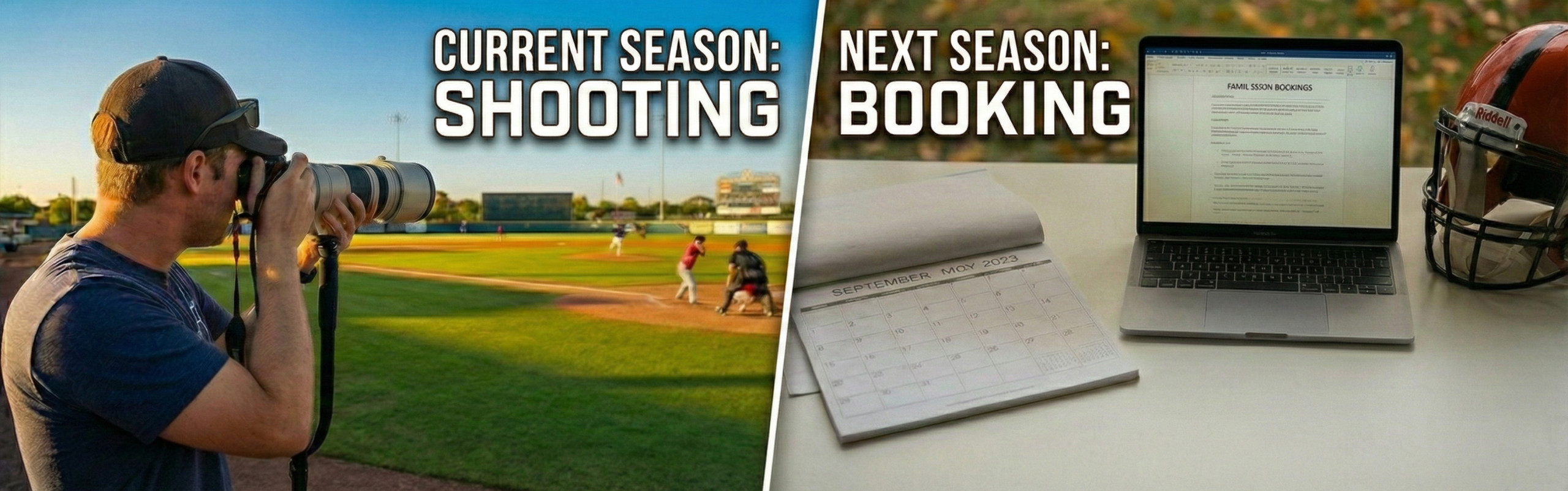
How to Book Next Season While Shooting This One
If you're prospecting one season ahead, you're already one season behind.
I learned this lesson the hard way. Years ago, I found what looked like the perfect league. Great demographics. Solid leadership. Engaged parents. The kind of account that could anchor an entire fall season.
There was just one problem.
I reached out in July. The decision had been made in March.
That's the moment most photographers discover a brutal truth: in volume sports photography, timing isn't just important—it's everything. And if you're prospecting one season ahead, you're already one season behind.
The two-season rule is simple: prospect two seasons ahead, not one. But knowing the principle and implementing it are two different things. Here are four STEPS to build a year-round prospecting calendar that puts you ahead of your competition.
Step 1: Map Your Year-Round Marketing Calendar
You can't book accounts whose decision timelines you don't understand.
Most photographers think linearly—fall sports happen in fall, so I'll prospect in summer. If that's your approach, you're already late.
Here's what actually happens: In January and February, league boards evaluate last fall's results. They're asking questions. Did parents complain? Were photos late? Did the photographer show up unprepared? By March and April, they're making decisions about next fall. By May, contracts are signed.
If you're reaching out in June or July? You're not early. You're late.
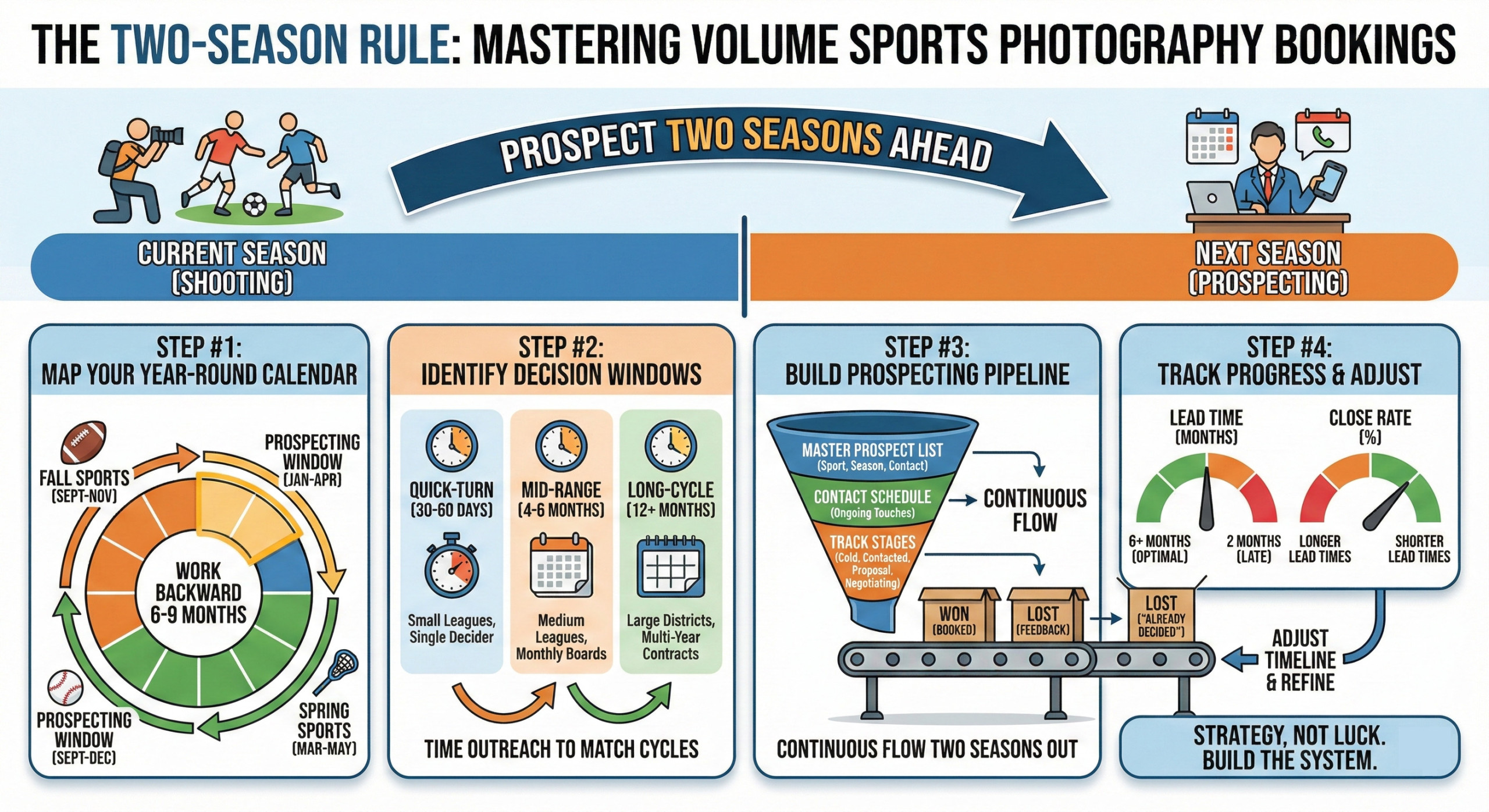
Your marketing calendar needs to reflect this reality. Map out every sport you want to shoot, then work backward two full seasons. Want fall football and soccer? You should be prospecting January through April. Want spring baseball and lacrosse? Start in September.
This isn't theory. Research shows complex organizational decisions typically take 4-12 months from problem identification to implementation. For volume sports photography contracts, that decision window opens even earlier.
Successful volume photographers have been using this approach for years. Right now we're about to start our spring season, so you should be prospecting for fall.
Step 2: Identify Decision Windows for Each Sport
Not all sports operate on the same timeline. Some leagues make fast decisions. Others move like molasses.
Your job is knowing the difference.
Start by researching your target accounts. When do they hold board meetings? When do they review vendor contracts? When does registration open? These milestones tell you when decision-makers are thinking about photography—and when your proposal needs to land on their desk.
Here's a practical framework. Break your target accounts into three categories:
Quick-turn accounts (30-60 days): Small leagues with single decision-makers. You can book these anytime, making them perfect for filling gaps in your schedule.
Mid-range accounts (4-6 months): Medium-sized leagues with boards that meet monthly. Reach out 4-6 months before their season starts.
Long-cycle accounts (12+ months): Large districts, multi-year contracts, entrenched competitors. These require relationship building and positioning yourself a full year or more in advance.
Once you've categorized your prospects, you can time your outreach to match their decision cycles—instead of your shooting schedule.
Step 3: Build Your Prospecting Pipeline Two Seasons Out
This is where most photographers fail. They understand the timing but don't build the system to execute it.
You need a prospecting pipeline that operates continuously, feeding opportunities two seasons into the future. Think of it like a conveyor belt: while you're shooting spring sports, you're closing summer camps, proposing to fall leagues, and building relationships for next spring.
Here's how to build your pipeline:
Create a master prospect list. Every league in your market gets added with key details: sport, season, estimated size, decision-maker, and contract renewal date if known.
Set up a contact schedule. Each prospect gets touched multiple times throughout the year—not just when you want to book them. Share helpful content. Congratulate them on successful seasons. Offer to answer questions. You're building relationship equity.
Track your pipeline stages. Use whatever system works for you—spreadsheet, CRM, sticky notes on your wall. But track where each prospect sits: cold lead, initial contact made, meeting scheduled, proposal sent, negotiating, won, or lost.
Work your pipeline weekly. Every week, move prospects forward. Make calls. Send emails. Schedule meetings. The photographers who dominate their markets don't prospect harder—they prospect more consistently.
Research backs this up. Strategic planning that considers long-term objectives alongside immediate needs leads to more sustainable growth. In practical terms: photographers who prospect continuously book more accounts at better margins than those who prospect reactively.
Step 4: Track Progress and Adjust Your Timeline
The system only works if you measure it.
Track two critical metrics: your lead time and your close rate by lead time.
Lead time is how far in advance you're making initial contact. Prospecting for fall sports in March? Your lead time is 6+ months. Prospecting in July? Two months or less.
Close rate by lead time tells you how timing affects your success. You'll likely discover what the data already shows: longer lead times improve outcomes.
Here's what to track each month:
How many prospects did you contact? What was the average lead time for those contacts? How many closed—and at what lead time? How many said “we already have someone” or “we already decided”?
That last metric is gold. Every time you hear “we already decided,” that's feedback. You were late. Adjust your calendar. Reach out earlier next year.
Review your metrics quarterly. Look for patterns. Are you getting better close rates at 6-month lead times versus 3-month? Are certain sports more predictable than others? Use this data to refine your approach.
The photographers who master this don't wing it. They track, measure, and adjust. They know exactly when to prospect for each sport in their market because they've tested and optimized their timing.
Here's the Bottom Line
The two-season rule isn't complicated. Prospect two seasons ahead instead of one.
Simple doesn't mean easy.
Most photographers will read this, nod along, and go right back to scrambling in July for fall accounts that were decided in March. They'll tell themselves they're too busy shooting spring sports to prospect for fall. They'll convince themselves they'll start next month.
Next month, they'll watch competitors book the accounts they wanted.
But imagine reaching out to leagues in January about next fall—while your competitors are prepping for spring season. Imagine decision-makers seeing your email and thinking, “Perfect timing. We were just talking about this.”
That's not luck. That's strategy. And it's available to you today.
What if the accounts you want next fall are making their decisions right now?
Your Next Step
I've created a Year-Round Marketing Calendar Template that maps out exactly when to contact prospects for each sport season. It includes the decision windows, contact schedules, and pipeline tracking metrics I outlined in this article.
You can access it free.


