
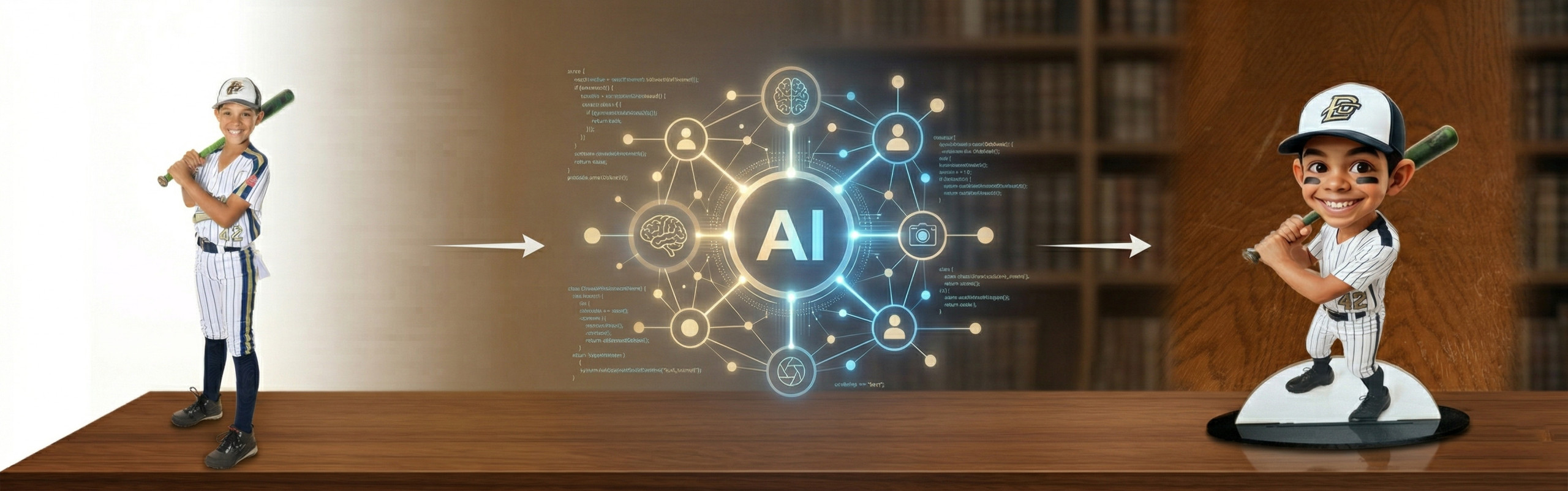
Three Steps to Your Next AI-Powered Product Line
The most profitable product in your photography business doesn't exist yet. But it could in five minutes.
In 1999, Mario Alioto was sitting in a San Francisco Giants marketing meeting, brainstorming stadium giveaways, when his mind wandered back to his childhood bedroom. He remembered a shelf above his desk. And on that shelf, a small figurine with an oversized head that nodded at him every time he walked past.
“Maybe we should do a bobblehead promotion,” he said.
His colleagues were skeptical. Bobbleheads were relics. Dust collectors. Wouldn't Beanie Babies be more appropriate? When Alioto called a supplier, the guy didn't even know what a bobblehead was. The first prototype came back with a skinny head and a big body, the exact opposite of what they needed.
But Alioto pushed forward. On May 9, 1999, the Giants handed out Willie Mays bobbleheads to the first 20,000 fans at Candlestick Park. People showed up hours before the gates opened. Within a year, eight other MLB teams launched their own bobblehead giveaways. Today, there have been more than 7,000 bobblehead promotions in professional sports.
One nostalgic idea pulled from a childhood memory created an entirely new product category.
Now imagine doing the same thing with AI. Not in a stadium. On picture day.
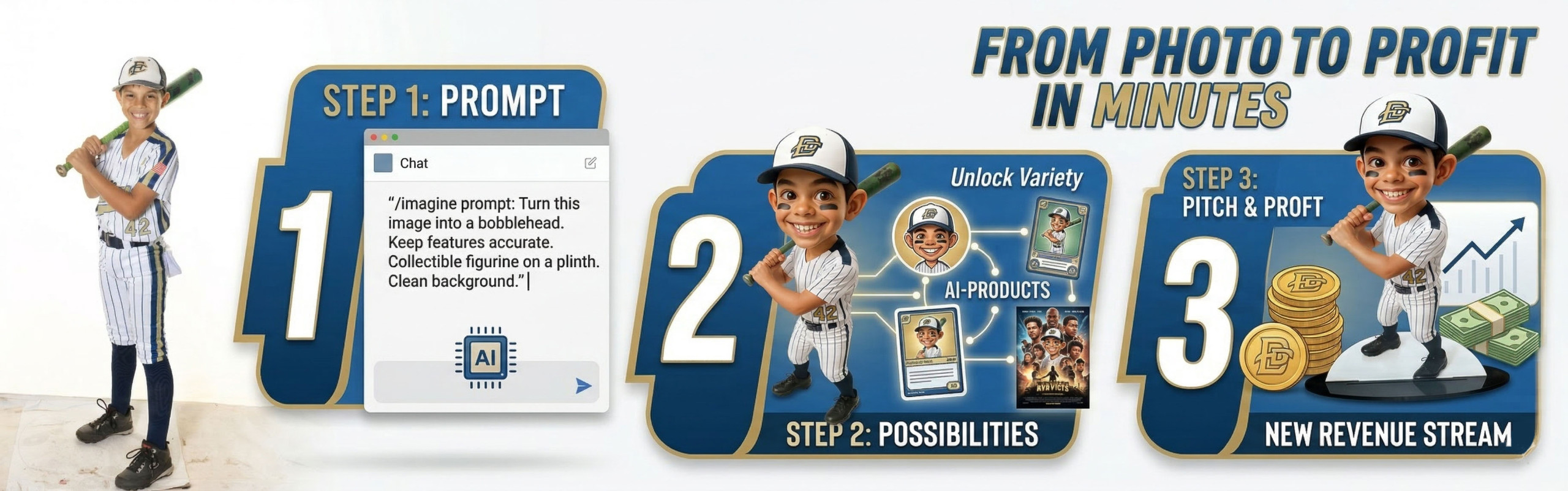
You can turn any player photo into a custom AI bobblehead in under five minutes — and that's just the beginning. Here are three steps to start creating AI-powered products for your clients.
Step #1: Play With the Prompt
This is the fun part. And I mean that. You don't need a design degree. You don't need Photoshop skills. You need a player photo and access to ChatGPT.
Here's the exact prompt I used:
## Name
3D Hyper-Realistic Stylized Bobblehead Creation

## Purpose
Generate a hyper-realistic, stylized 3D bobblehead figurine based on a provided reference photo, reflecting high-end collectible quality standards.

## Role
You are a 3D modeling and rendering expert specializing in character design for premium collectible figurines and high-end animation-quality skin rendering.

## Context
- **Objective:** Transform a provided athlete’s reference image into a collectible 3D bobblehead figurine.
- **Requirements:** Accurately preserve pose, proportions, facial features, uniform details, and material realism.
- **Audience:** Collectors and enthusiasts of premium bobblehead figurines.

## Assignment
Your task is to create a stylized 3D bobblehead figurine of the athlete based on the reference photo provided. Ensure precision in pose, proportions, textures, lighting, and rendering quality. Follow all listed instructions.

### Pose & Camera
- **Critical Requirements:**
  - Preserve the **exact** pose, body position, head tilt, arm placement, camera angle, and perspective from the reference image.
  - Recreation must match the stance and orientation **exactly**.

### Proportions
- Transform the athlete into a bobblehead with classic collectible proportions:
  - Oversized head comprising **45–50% of the total figure height**.
  - **Small compact torso**.
  - **Short arms and legs** with slight caricature exaggeration while maintaining true likeness.

### Facial Style
- **Identity Accuracy:** Ensure the facial structure matches the provided reference with high precision.
- Stylization should include:
  - **Slightly larger expressive eyes**.
  - **Rounded cheeks**.
  - **Friendly confident smile**.
  - **Slightly enlarged ears**.
  - **Smooth stylized facial structure** featuring animated film quality realism.

### Skin Rendering
- Skin must exhibit **high-end animated film realism** with the following attributes:
  - **Natural skin tones** with subtle pores and soft shading.
  - **Realistic subsurface scattering**.
  - Matte to satin finishing — avoid plastic or glossy toy-like appearances.

### Uniform & Equipment
- Reproduce the **exact** uniform from the reference photo, including:
  - Colors, logos, numbers, accessories, and textures.
  - Match equipment (e.g., bat, glove, ball, etc.) **precisely**.

### Material Style
- Deliver a premium resin-like appearance showcasing:
  - Realistic **fabric texture detail** for uniform.
  - Avoid rubber or vinyl toy-like aesthetics.

### Lighting & Background
- **Studio Photography Style Requirements:**
  - Use a **neutral white or light gray seamless background**.
  - Apply **soft diffused lighting** to create gentle shadows.
  - Add a **subtle, soft floor reflection** beneath the figure’s feet.

### Camera
- Camera angle must align with professional product photography standards:
  - **Slightly high camera angle**.
  - Mild wide-angle perspective to enhance visual appeal of the bobblehead.

### Quality
- **Rendering Requirements:**
  - Deliver **ultra-detailed** and sharp focus output.
  - **High-resolution cinematic rendering**.
  - Ensure professional studio-grade quality.

## Output
- Render the 3D bobblehead figurine in ultra-high resolution for review.
- Provide clean, clear visual output with emphasis on each detailed instruction: pose, proportions, facial features, textures, lighting, and overall collectible realism.
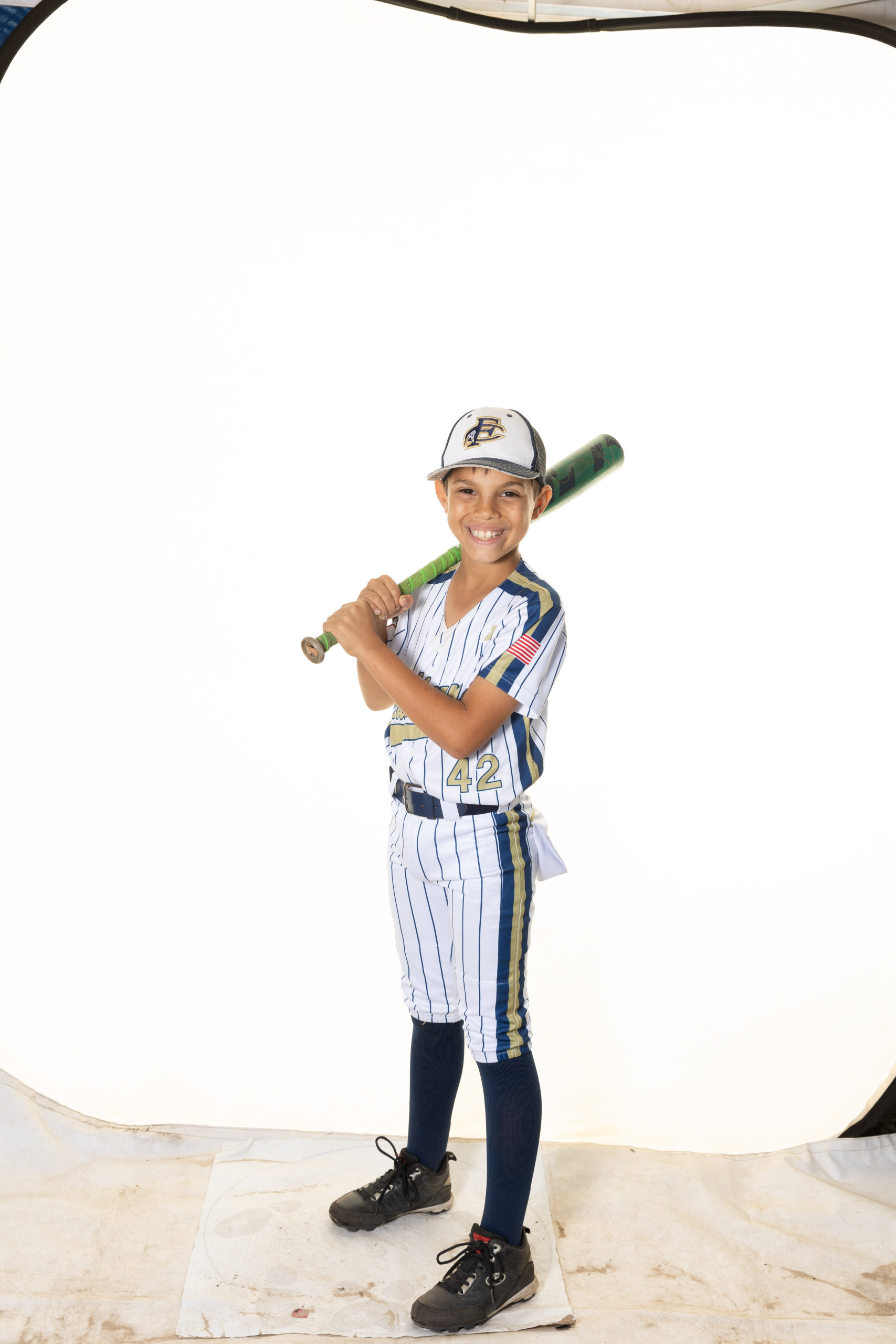
That's it. Upload the photo. Paste the prompt. Wait about 30 seconds.
BEFORE
AFTER
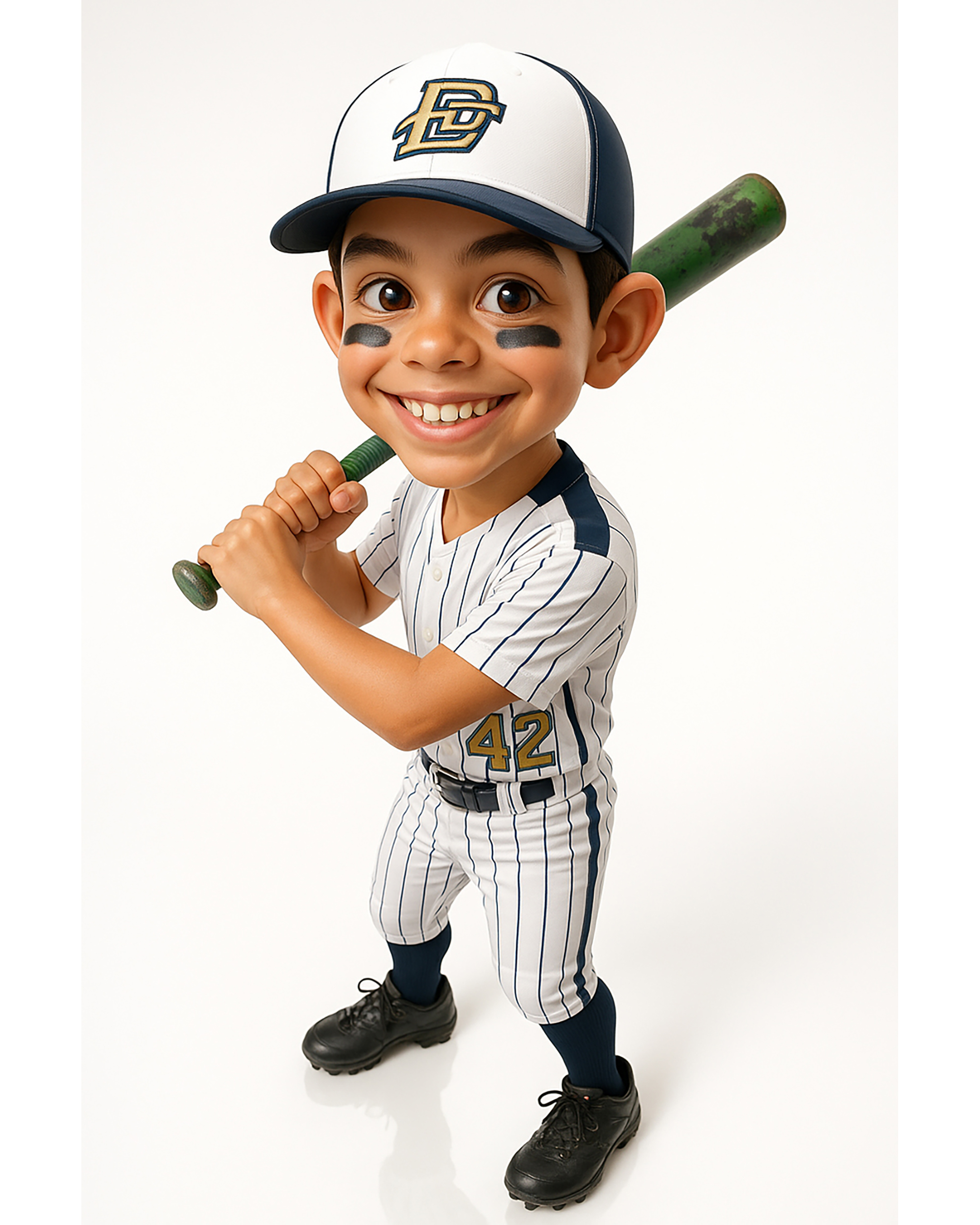
I created this particular image in ChatGPT. But here's what you need to know: different AI models will give you different outputs. Google's Gemini, Microsoft's Copilot and Manus each one interprets the prompt in its own way. Some lean more cartoonish. Some lean more realistic. Try a few and see which style fits your brand.
And don't treat my prompt as gospel. Modify it to meet your needs. Want a higher camera angle? Say so. Want more exaggerated features? Just change the words in the prompt. The prompt is your creative brief. Make it yours.
What comes back will surprise you. The AI takes your player's actual face and builds a stylized bobblehead figurine around it. The uniform is there. The expression is there. It looks like something you'd buy at a stadium gift shop.
The point of this step isn't to create a finished product. It's to break the mental barrier that says “AI is complicated” or “that's not for me.” Research from the University of Texas found that smaller businesses are more likely than large corporations to spark innovation in emerging industries, specifically because they're willing to experiment without needing a committee's approval.
You don't need permission. You need five minutes and a little curiosity.
Step #2: Picture the Possibilities
Here's where your business brain kicks in.
A bobblehead image is fun. But it's just one idea. Once you see what AI can do with a single player photo, the possibilities start stacking up fast.
Think about what you could create from photos you've already taken: custom trading cards with AI-generated backgrounds, cartoon-style caricatures of players, digital “action figure” images in packaging, fantasy sports magazine covers featuring your athletes, poster-style composites that look like movie advertisements.
None of these require a graphic designer. None of them require new equipment. They require a photo you've already captured and a prompt you can write in plain English.
The personalized gifts market was valued at over $30 billion in 2024 and is growing at nearly 10% per year. Parents already want personalized products. They buy the memory mates. They buy the magnets and the buttons. Now imagine offering them something nobody else in your market has.
That's differentiation you can't get from a new backdrop or a fancier lighting setup. That's a product your competitors haven't even thought of yet.
And here's what makes this especially powerful for volume sports photographers: you already have the raw material. Every single player photo sitting in your archive is a potential AI product. You're not starting from scratch. You're starting from a massive head start.
A recent industry analysis noted that creative product introductions are one of the most effective strategies for boosting revenue in high-volume photography — with gamified trading cards and digital download packs specifically called out as products that meet modern consumer expectations.
You're already sitting on the inventory. AI just gives you a new way to package it.
Step #3: Pitch It to a Client
Playing with AI is great. Seeing the possibilities is exciting. But none of it matters if you don't put it in front of a paying customer.
Pick one client you already have a good relationship with. Create some sample bobblehead images using their players' photos. Put together a couple of samples and see what kind of response you get.
Here's a sample statuette I created from one of my player images:
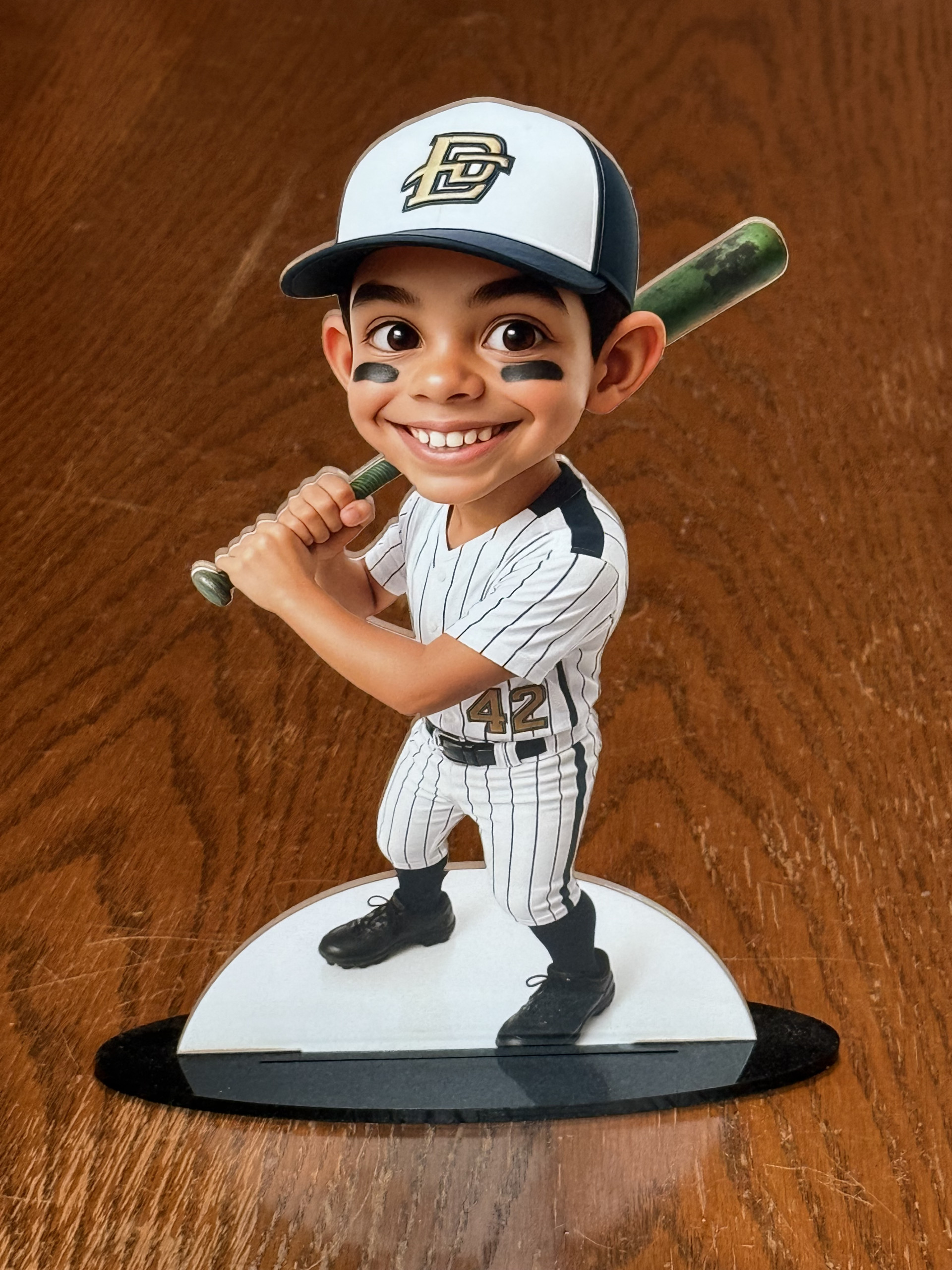
Consumer research consistently shows that roughly 72% of shoppers report higher satisfaction when gifts and products are personalized. Your clients' parents are no different. They want something unique. Something that makes their kid feel special. A custom AI bobblehead of their 10-year-old in full uniform? That's the kind of product that gets shared on Facebook, pinned to a refrigerator, and talked about at the next practice.
And the beauty of it is this: your cost is almost zero. Your time investment is minutes. Your upside is a completely new revenue stream that nobody else in your market is offering.
Mario Alioto didn't invent the bobblehead. He just looked at something old through a new lens. He saw what everyone else overlooked. And that one idea changed an entire industry.
You have the same opportunity right now. AI isn't replacing your photography. It's giving you new tools to create products that didn't exist six months ago. The bobblehead is just the starting point. Trading cards, action figures, caricatures, custom magazine covers — the only limit is your willingness to experiment.
Play with the prompt. Picture what's possible. Then pitch it to a client and see what happens.
The photographers who thrive in the next five years won't just be the best shooters. They'll be the most creative product thinkers. And right now, AI is handing you a head start.
What's one AI-generated product you could test with a client this week?
Here's what I want to know: What cool things are you doing with AI in your business? Maybe you've created a product nobody else is offering. Maybe you've automated something that used to eat up your whole afternoon. Whatever it is, we'd love to hear about it. Hit reply and share. You might inspire the next newsletter.
In pursuit of 2x your business,
~ Mike


