
AI won't replace photographers, but photographers using AI will outpace those who don't.
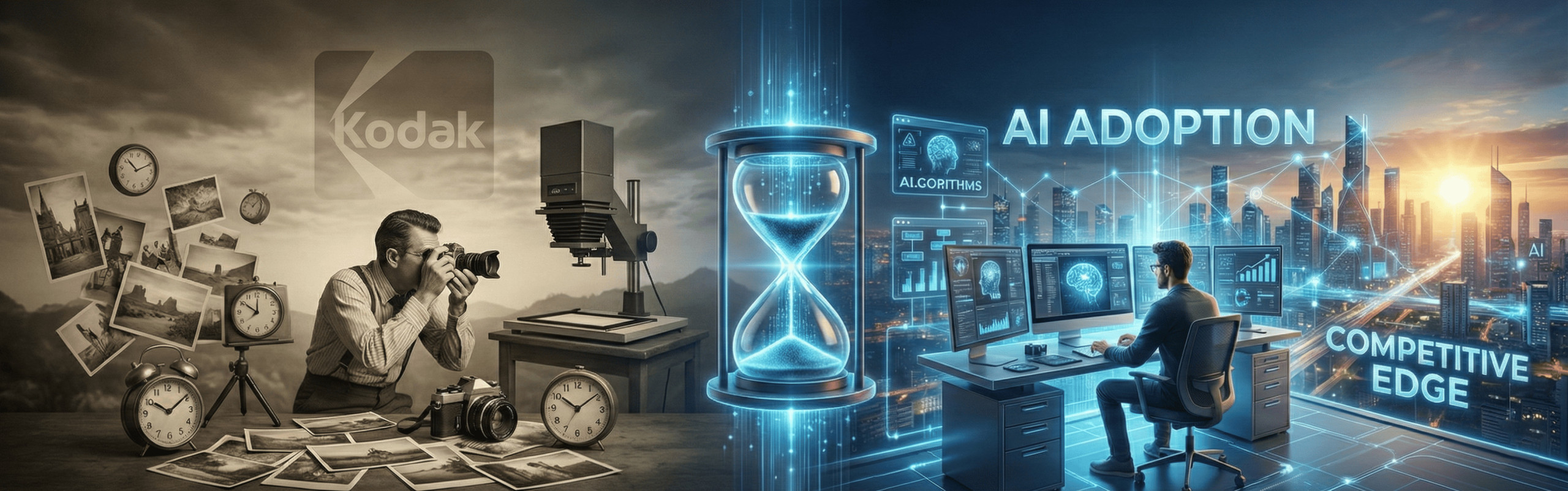
In 1975, Kodak engineer Steve Sasson invented the world's first digital camera. He showed it to executives, who looked at the grainy 0.01-megapixel image on a television screen. The technology worked. The future was right there in front of them. But instead of celebrating, Kodak leadership asked one question: “Why would anyone ever want to look at their pictures on a television?” They shelved the invention, convinced it would cannibalize their profitable film business. Thirty-seven years later, in 2012, Kodak filed for bankruptcy. The company that literally invented digital photography was destroyed by it—not because they didn't see it coming, but because they were too afraid to act on what they saw.
You already know AI is coming. The real question is whether you'll use it to gain a competitive edge or wait until your competitors force you to play catch-up. Here are three compelling realities that prove AI implementation is the smartest business decision you can make this year.
Table of Contents
ToggleReality #1: Early Adopters Win, Late Adopters Survive, Non-Adopters Exit
Here's what's happening right now in the photography industry: the photographers implementing AI are reclaiming their time, cutting their costs, and scaling their businesses. The ones waiting to see what happens are falling further behind every single day.
The numbers don't lie. According to data from Aftershoot, photographers using AI automation saved an average of 473 hours in 2025—that's nearly twelve full workweeks returned to their calendar. Think about what you could do with an extra twelve weeks. You could shoot more events. Build better client relationships. Actually take a vacation without your laptop.
But here's the thing: those time savings translate directly into competitive advantage. While you're spending three hours culling a single event, your AI-equipped competitor is delivering galleries in forty-five minutes. While you're editing until midnight, they're prospecting new schools. While you're drowning in post-production, they're already moving on to the next shoot.
A 2025 study found that 76% of small businesses adopting AI photography tools reported cost savings exceeding 80%. That's not incremental improvement. That's transformation. And the photographers capturing those savings aren't just working less—they're winning more business, delivering faster, and building stronger reputations.
Early adoption creates a window of opportunity. Right now, AI gives you an edge because most of your competitors haven't implemented it yet. But that window won't stay open. In twelve months, AI won't be your competitive advantage—it'll be table stakes. The photographers who move now will own the market. The ones who wait will spend the next five years playing catch-up.
Reality #2: AI Doesn't Replace Photographers—It Replaces Photographers Who Don't Use AI
Let me say this clearly: AI is not coming for your job. But photographers who use AI will absolutely outperform photographers who don't.
The fear around AI replacing photographers misses the fundamental point. Research from Boston Consulting Group found that AI doesn't make workers obsolete—it makes them more capable. Employees using AI reported productivity increases ranging from 14% to 40%, with the greatest gains coming from AI augmentation rather than automation. AI isn't replacing the strategic thinking, the client relationships, or the creative eye that makes you valuable. It's eliminating the tedious execution work that bogs you down.
Think about your workflow. How much time do you spend culling duplicates, adjusting exposure on hundreds of images, or removing blemishes one face at a time? Those aren't the tasks that showcase your talent. They're the tasks that keep you from your talent.
AI handles the repetitive work—flagging closed eyes, selecting sharp images, applying consistent color correction—while you focus on the decisions that actually require human judgment. Which moment tells the story? What angle captures the emotion? How do you build trust with a nervous team mom?
A February 2025 study from the Federal Reserve Bank of St. Louis found that workers using generative AI saved an average of 5.4% of their work hours—roughly 2.2 hours per week. But productivity gains were highest when workers used AI to enhance their existing capabilities, not replace them. That's the key insight: AI amplifies what you already do well.
Your competitors aren't adopting AI because it makes better creative decisions than you do. They're adopting it because it frees them to make more creative decisions while you're still stuck in Lightroom at 11 PM.
Reality #3: The Window for Competitive Advantage Is Closing Fast
In 2025, Aftershoot users processed 8.8 billion images using AI-powered culling and editing. That's not a small group of tech-savvy early adopters. That's 188,000 photographers who've already made the shift.
The AI photography market is projected to reach $8.9 billion by 2034, with a compound annual growth rate of 15.7%. Translation: AI in photography isn't a trend. It's a market transformation happening in real time.
And here's what that means for you: the competitive advantage AI offers right now—the ability to deliver faster, work more efficiently, and undercut competitors on turnaround time—won't last forever. As adoption increases, AI shifts from differentiator to requirement. The photographers implementing AI today are building operational advantages their competitors will spend years trying to match.
Over 50% of photographers already use AI for business tasks like social media content creation and client communication. Your market isn't waiting to see if AI works. They're already using it. The question is whether you'll be ahead of the curve or behind it.
Think about the schools and leagues in your market. When two photographers bid for the same contract and one promises three-day delivery while the other needs two weeks, who do you think wins that deal? When one photographer can offer competitive pricing because their labor costs are 80% lower, how does the other one compete?
The window for first-mover advantage is still open, but it's closing. Every month you wait is a month your competitors get further ahead. Every season you delay is a season of opportunities lost to photographers who moved faster.
The Bottom Line
AI isn't replacing photographers. It's separating the photographers who evolve from the ones who get left behind. Early adopters are gaining ground, cutting costs, and building businesses that run leaner and faster than ever before. Late adopters will survive, but they'll spend years catching up. Non-adopters? They'll exit.
Imagine what becomes possible when you're not spending twelve hours a week on post-production. Imagine delivering galleries in a day instead of a week. Imagine competing on speed, quality, and price—all at the same time. That's not a future scenario. That's what's happening right now for photographers who've already made the shift.
Kodak invented the technology that would have saved them. They had the knowledge, the resources, and the opportunity. What they didn't have was the willingness to act.
So here's the question: Will you be Kodak, or will you be the company that put them out of business?
Want More AI Content for Photographers?
If you found this article valuable, let me know. I'm considering creating more AI-focused content specifically for volume sports photographers—practical guides on which tools actually work, how to implement them in your workflow, and real strategies to stay competitive. Reply to this email or drop a comment to tell me if this is the kind of content you want to see more of.


