
Table of Contents
ToggleThe three pieces: Scrape, Sync, Send
Tuesday, 9:30 a.m. The first cold email went out to a gymnastics studio forty miles away. I was on my second cup of coffee, and my new salesperson was already working the list.
Last week I told you my best salesperson costs twenty dollars a month. This week I'm going to show you the receipts.
Here's what happened. Fall booking season is bearing down on us, and gymnastics and cheer studios are great Fall accounts. In the old days, filling that calendar meant a week of grinding: building a list of every studio within a 50 mile radius, hunting down owners' names, writing emails one at a time, then trying to remember who needed a follow-up and when. Frankly, the follow-up part is where it always fell apart. Nobody remembers to send the fourth email on day 18. Not when they're running picture days.
So this time we didn't do any of that.
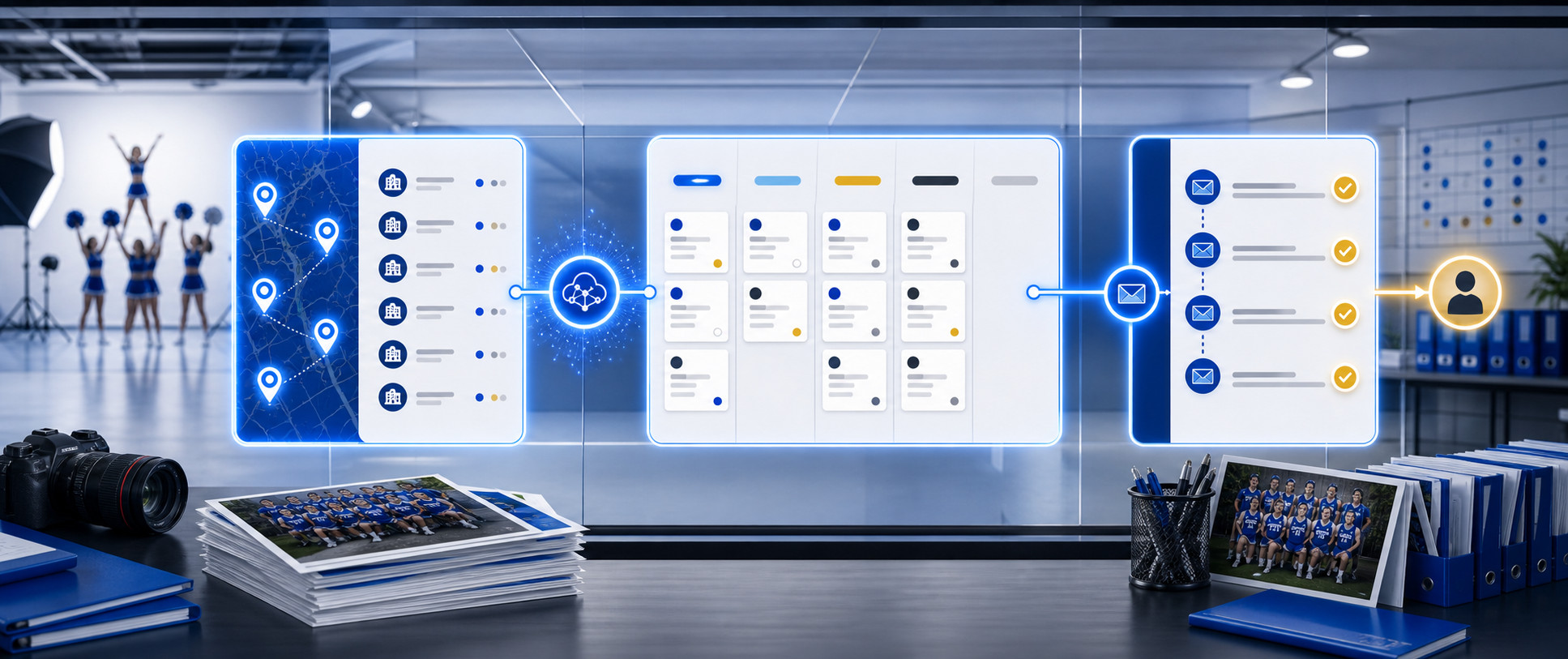
Instead, we had AI scrape every gymnastics and cheer studio in our area into a clean list. That list flowed straight into our CRM, no copying and pasting. And the CRM now sends every studio a four-email sequence over 18 days: intro, how it works, hold your date, and a graceful goodbye. Written once, in our voice. Sent automatically. The moment a studio replies, the AI sales bot pulls them out and a human takes over.
We kicked it off with one click. No launch meeting, no checklist, no week of grinding. The machine took it from there.
Today, I'm going to walk you through exactly how we built it.
You don't need to be a programmer to build this, and you don't need a sales team to run it. You can build the same outreach machine we did by putting three pieces in place: a scraper that finds your prospects, a CRM that catches them, and a sequence that works them. Let me show you each one.
Piece #1: Scrape the List
Every outreach effort lives or dies on the list, and the list is where most photographers quit before they start.
There's a reason for that. Salesforce's latest State of Sales research found that sales reps spend almost one full day of their workweek just on prospecting, and nearly half of them call it one of the worst parts of the job. That's professional salespeople, with tools and training, burning a fifth of their week finding people to talk to. No wonder a photographer with three picture days and a backlog of orders never get to it.
Here's the thing: list-building is exactly the kind of work AI does best. It's repetitive, it's research-heavy, and there's a clear finish line.
So that's where we started. We told our AI employee precisely who we wanted: every gymnastics and cheer studio within our service area, with the studio name, website, location, and the best contact email it could verify. Then we let a scraping tool do the digging while we did something better with the afternoon.
What a clean list looks like
The output is a simple spreadsheet, one row per studio, with the same columns every time. That structure matters more than it sounds. A consistent list is what lets the next piece of the machine grab it without a human re-typing anything.
What used to take days of squinting at Google Maps and studio websites came back to us in minutes. Was every row perfect? No. We spot-checked it, tossed a few duds, and tightened the workflow for next time. Call it 15 minutes of cleanup on a list that used to cost a full day.
Piece #2: Sync the CRM
A list in a spreadsheet is potential. A list in your CRM is a pipeline. The second piece of the machine moves your prospects from one to the other with no human in the middle.
Why does that matter so much? Because manual data entry is where good intentions go to die. HubSpot's research found that nearly a third of salespeople spend an hour or more every single day just entering data, and every one of those minutes comes straight out of time they could spend selling. For you, it's worse. That hour comes out of editing, shooting, or dinner with your family.
So we connected the scraper's output directly to our CRM. Every studio on the list landed as a contact, tagged as a gymnastics prospect, and dropped into a pipeline built for this campaign. No copying. No pasting. No “I'll import these this weekend.”
The catcher's mitt
Think of your CRM as the catcher's mitt for everything the scraper throws. Once a prospect lands, the CRM knows who they are, what campaign they belong to, and what should happen to them next. It tracks every email sent, every open, every reply.
This is the piece photographers most often skip, and it's the piece that makes the whole machine trustworthy. Without it, you're back to sticky notes and memory. With it, nothing falls through the cracks, ever.
Piece #3: Send the Sequence
The third piece is the one that actually books the calls: a four-email sequence, written once, sent automatically on a fixed cadence. Ours runs on days 0, 5, 11, and 18. Intro. How it works. Hold your date. And a graceful goodbye.
Now, here's the number that should change how you think about follow-up. Backlinko analyzed twelve million outreach emails and found that sending just one additional follow-up boosts replies by 65.8 %, and sequences of three or more messages get the best response rates of all.
Read that again. The single highest-leverage move in cold outreach isn't a cleverer first email. It's the second email. And the third. The ones almost nobody sends by hand.
That's the quiet genius of this piece of the machine. You write the sequence once, in your voice, with your proof and your offer. The CRM sends every message, to every studio, on schedule, whether you're shooting a Saturday tournament or sitting at your kid's baseball game.
The rule that keeps it human
One rule makes all of this work: the moment a prospect replies, the machine stops and a person steps in. Nobody gets a robot conversation. The automation handles the part humans are bad at, which is persistence. Humans handle the part machines are bad at, which is relationship.
That's not replacing you. That's protecting the work only you can do.
The Bottom Line
The whole machine is three pieces. Scrape the list, so finding prospects costs minutes instead of days. Sync the CRM, so every lead lands in a pipeline instead of a spreadsheet you'll get to someday. Send the sequence, so every studio gets every follow-up, every time, in your voice.
We built ours in an afternoon. It's working our fall list right now, while I write this newsletter.
Imagine your version of this. Every dance studio, every league, every school in your radius, contacted and followed up with before your competition has even opened their laptop. Your calendar filling while you're behind the camera, where you belong, or at the dinner table, where you also belong. That's the Double Win this machine was built for: a business that grows and a life you actually get to live.
If the machine only needs an afternoon to build, what's the real reason your outreach still runs on memory and good intentions?
P.S. Last week I mentioned we might run a class that walks you through this exact build, step by step, your market instead of ours. Interest is stacking up, so it's looking likely. If you want first access when we open it, [add your name to the list here] and you'll be the first to know.
In pursuit of 2x your business,
~ Mike


